
CSD La Grande Mulette dredging the Bidassoa
These operations are part of an important dredging campaign that aims at restoring the required depth in three assets of the port.
Besides the maritime access this comprises the marina and the fishing port.
Dredging of the marina has been carried out in 2025, bringing the depth to CM -2.5 m (CM = Cote Marine) involving some 35,000 m3 material.
In France, Cote Marine is the hydrographical reference that corresponds to the lowest astronomical tide.
While the marina has been dredged with a grab hopper dredger, i.e. the Fort Boyard, for the maritime access in the Bidassoa river, a cutter suction dredger (CSD) is being deployed.
Both the Fort Boyard and the cutter suction dredger, carrying the name La Grande Mulette, are owned by the French Department Charente-Maritime, which was the lowest bidder for these works.
The dredging operations are being carried out for the account of the Municipality of Hendaye and the Department Pyrénées-Atlantiques, the latter being the owner of the port and the Municipality being the manager as part of a long term concession.
Dredging the Bidassoa represents some 90,000 m3 of material consisting of medium fine sand with a grain size between 125 and 250 µm.
The properties of the sand make it suitable for beneficial re-use and in this case it is being used to replenish a section of approx. 800 metres of the beach of Hendaye.
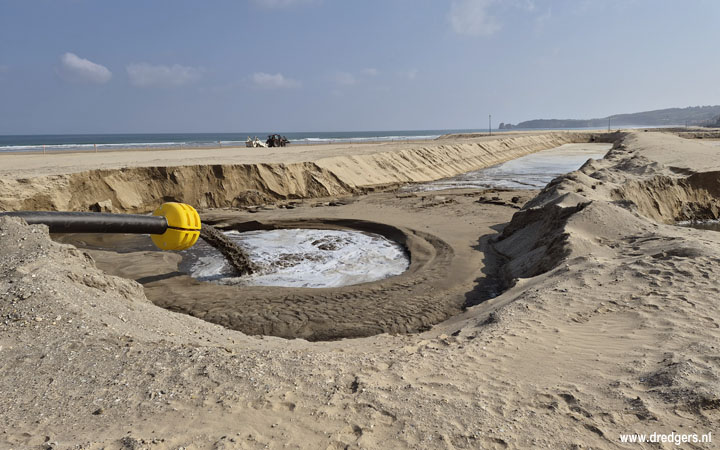
The dewatering basins
From the dewatering basin, the sand is transported to the beach by means of dumpers.
The dewatering basin consists of three compartments, the first are being used alternately for filling and emptying after the dewatering process.
Both these compartments have a overflow to the third compartment where a final settlement of the finest parts can take place before the water is discharged back to the sea.
Once the dredging of the Bidassoa has been completed, the depth in the maritime access will have been brought to CM - 3 metres.
The third stage of the dredging campaign, covering the fishing port located in the bay of Txingudi, is scheduled to be carried out in 2027.
By then, the fishing port will also be brought to a depth of to CM - 3 metres.
The dredging operations are being carried out with great concern for the environment.
Thresholds with respect to turbidity and biological impact have been defined that are closely monitored.
In particular the zostera marine, also known as eelgrass, is considered as a highly valuable species in the bay of Txingudi.
For the environmental monitoring and evaluation, the specialised company Egis has been contracted.
A second similar dredging campaign is scheduled to take place between 2029 and 2032.