Dredging for the Oosterweel Project

After the immersion process already had started the previous day, on the early morning of 15 December 2025 the last of eight tunnel elements of the new Schelde tunnel near Antwerpen (Belgium) has been placed successfully in the pre-dredged trench across the river Schelde.
The new tunnel will be part of the Oosterweel link that after its completion will drastically improve the traffic situation around the city of Antwerpen.
The new link is scheduled to be taken gradually into service as of 2028, first only for cyclist and in 2030 also for motorised traffic.
Construction of the new tunnel is being carried out by the consortium TM COTU for the account of Lantis, a company of the Flemish government that is dedicated to implement mobility projets in the region of Antwerpen.
The consortium TM COTU consists of the partners Besix, DEME, Jan De Nul and Stadsbader.
With each tunnel element weighing approx. 60,000 tonnes and an alignment tolerance of 35 mm, every immersion is a highly delicate operation.
Successful placement of the elements is dependant on many factors, efficient and accurate dredging is one of them.
There are four different kind of dredging activities that need to be carried for this tunnel project:
| 1. | Initial bulk dredging of the tunnel trench
|
| 2. | Precision dredging for the final profiling of the trench
|
| 3. | Maintenance dredging to keep the trench in the required profile through the construction period
|
| 4. | Backfilling after the placement of the tunnel elements
|
Bulk dredging

The Fernão de Magalhães dredging the trench, 25 April 2025
For the initial bulk dredging of the trench, the joint venture has deployed Jan De Nul's heavy duty cutter suction dredger Fernão de Magalhães.
Between 21 April and 29 May 2025, it has dredged some 1,35 Million m3 of material, of which 900.000 m3 was reusable sand.
The remaining 450.000 m3 consisted of a variety of clay like material, amongst other very stiff material known locally as "Boomse klei".
During this operation the dredged material was loaded into hopper barges that brought it depending of the kind to two different relocation sites.
The reusable sand was brought to the "Noordelijk Insteekdok" in the port of Antwerpen where it was temporarily stored to be later reused for the backfilling operation.
The other material was brought to dedicated relocation sites along the river Schelde.
Precision and maintenance dredging

The Mimar Sinan in action, 2 July 2025
Just before every placement of a element, precision dredging was carried out to bring the relevant part of the tunnel exactly on the required profile.
For this operation Jan De Nul's backhoe dredger Mimar Sinan together with the hopper barge Arent as well as several plough dredgers, amongst other the Pieter Coecke and the C-Horizon, were used.
Furthermore, to reach optimal accuracy, a dedicated dredge pontoon has been developed that is equipped with an A-frame and a DOP pump.
For its horizontal positioning this pontoon is coupled to a DP2 equipped workboat, while the pontoon itself is foreseen with system for vertical positioning of the DOP pump.
The Schelde is a tidal river with strong currents and as such it carries a lot of material that is susceptible to sedimentation.
Obviously, once a trench has been dredged across the river, it will act as a sedimentation trap and this phenomenon was accounted for.
Between the placement operations of the tunnel elements and throughout the entire construction period, the Mimar Sinan and the plough dredgers were also deployed to carry out the maintenance dredging of the trench.
Backfilling
Finally, for the backfilling operation two types of equipment are being used.
First, it is DEME's trailing suction hopper dredger Pallieter that dredges the sand from the temporary store in the "Noordelijk Insteekdok" and transports it to the tunnel site.
Here it couples to a floating pipeline that is connected with the spray pontoon DN10.
With this spray pontoon the sand is carefully positioned under and next to the tunnel element.
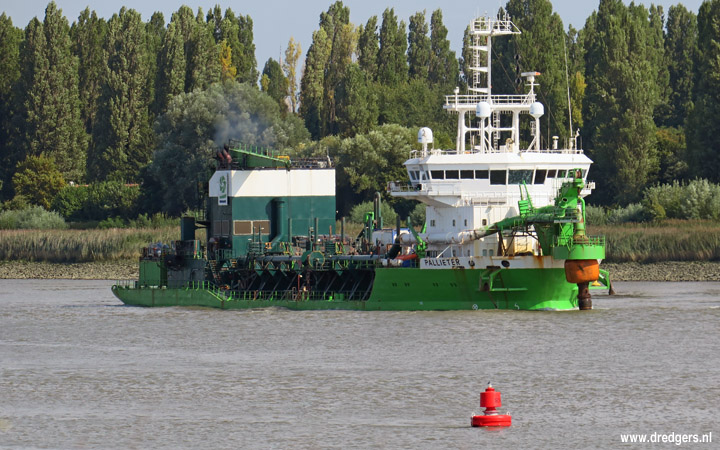

The Pallieter and the DN10 doing a backfilling operation, 15 August 2025
Shifting the navigation channel
One of the main challenges of the project was that during the dredging works, the regular shipping traffic on the may not be hindered.
To make this possible, by the beginning of the project, the river was temporarily widened over a length of 85 m at the south bank of the project site.
This allowed for shifting the navigation channel to either the northern side or the southern side depending on the stage of the project.
With additional width, in both cases enough space for the vessel traffic was left.
Shifting from the southern side to the northern side took place both halfway the bulk dredging as well as the stage of the element placing.